
Establishing a legacy fund is one of the most meaningful ways a donor can give. It reflects a long-term commitment to the causes and communities they care about, ensuring that their generosity continues to make an impact for years to come.
But creating the fund is only part of the process. Some of the most important decisions, the ones that determine whether a fund truly endures as intended through strong legacy fund governance and succession planning, are often the ones donors are least likely to consider.
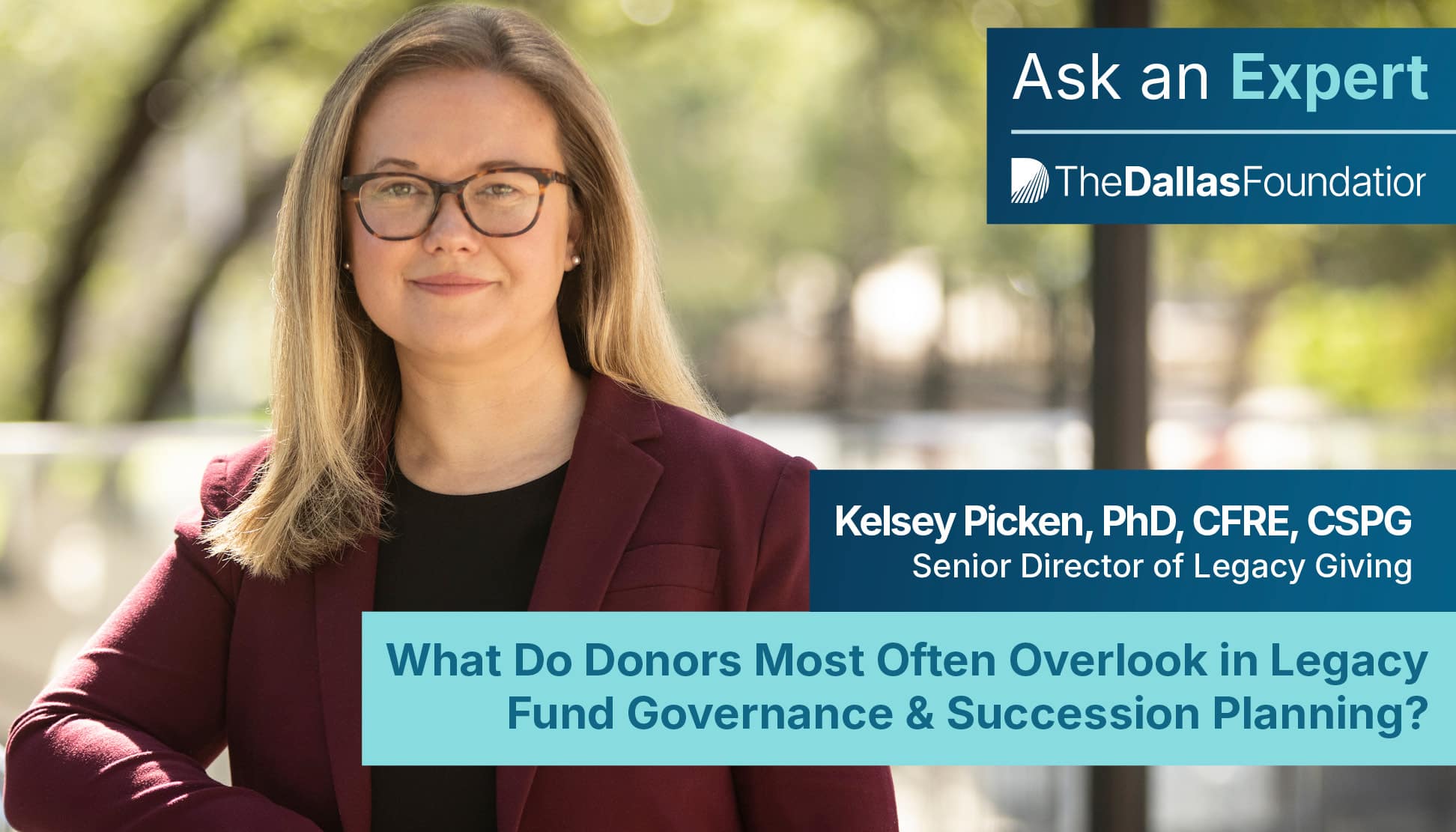
In this edition of Ask an Expert, Kelsey Picken, PhD, CFRE, CSPG, Senior Director of Legacy Giving at The Dallas Foundation, shares the governance and succession questions donors commonly overlook, and how addressing them early can help ensure a legacy is carried forward as intended.
What is the most common oversight when it comes to successor advisors?
The most common oversight is simply not naming one. Donors who establish a donor-advised fund or a named endowment often assume that the fund will continue to operate on its own, that the community foundation will manage the assets and make grants more or less automatically. In some cases, that is true by design. But when a donor has established a fund with active advisory privileges, or when they have family members they expect to continue the giving tradition, the question of who steps into that role after the donor passes is not a minor administrative detail. It is a foundational question.
A related oversight is naming a successor without having the conversation with that person first. I have seen situations where a spouse or adult child is listed as the successor advisor but has never been told, and has no interest in taking on that responsibility, or no knowledge of the fund’s purpose, history, or values. A name on a document is not the same as a prepared successor. The two are very different things.
At The Dallas Foundation, we encourage donors to have an explicit conversation with their intended successors well in advance. We can also be a resource in that process, helping donors articulate their philanthropic values in writing and ensuring that the fund’s purpose is documented clearly enough to guide future decision-making, even generations from now.
How should donors think about multi-generational family involvement in a legacy fund?
This is one of the places where the gap between intention and documentation is widest. Many donors express a strong desire for their children and grandchildren to carry on their giving tradition. They want the fund to be a touchstone for family values, a mechanism for bringing generations together around the act of giving. That is a beautiful vision, and one that The Dallas Foundation actively supports through our Family Philanthropy services, and one we are proud to help families bring to life.
But vision alone is not structure. Donors need to think carefully about how family involvement will actually work in practice. Who has advisory authority, and when does that authority transfer? What happens if family members disagree about grant recommendations? Is there a process for adding or removing advisors over time? Does the donor want future generations to have full discretion to redirect the fund’s purpose, or do they want the original charitable intent protected? Our recent Ask an Expert on how the next generation is redefining philanthropy offers helpful context on why these questions matter more than ever.
These questions do not have universal answers. What matters is that the donor has thought them through and that the answers are reflected in how the fund is structured. A legacy fund that is built on clear governance, even simple governance, is far more likely to function as intended than one that relies on family members to work it out among themselves.
Are there governance questions specific to endowments that donors tend to miss?
Endowments tend to raise a specific question that donors often underestimate: what happens if the intended beneficiary organization no longer exists, changes its mission significantly, or becomes unable to accept grants in the way the donor envisioned? This is more common than people assume. Organizations merge, evolve, close, or shift their programmatic focus over time.
Donors who establish endowments restricted to a single organization often have not thought through what should happen in those scenarios. The fund documents may be silent on the question, which places the stewardship burden entirely on the community foundation to interpret the donor’s intent. A well-drafted endowment agreement will anticipate this kind of contingency, providing guidance on how to redirect distributions if the original grantee is no longer an appropriate recipient, and what process should be used to make that determination.
Similarly, donors sometimes overlook the question of what voice, if any, they want their family or estate to have if the endowment’s terms need to be modified over time. Building in a consultation process, or explicitly deferring to the community foundation’s judgment, is far better than leaving the question open.
What practical steps can donors take to strengthen the governance of their legacy fund?
I would encourage every donor to take three steps, regardless of the size or structure of their fund.
The first is to write down their philanthropic intent in plain language. Not a legal document, just a clear, honest articulation of why the fund exists, what causes or organizations it is meant to support, and what values should guide future grant-making. This document does not need to be long. It needs to be clear.
The second is to name a successor advisor and to prepare that person for the role. Have the conversation. Share the giving history. Introduce them to the team at the community foundation. Make sure they understand both the mechanics of the fund and the spirit behind it.
The third is to revisit the fund periodically, ideally every few years or when a significant life change occurs. A legacy fund is not a static instrument. Families change, organizations evolve, priorities shift. The governance provisions that made sense when the fund was established may need to be updated to reflect a donor’s current circumstances and intentions.
Our philanthropic advisors are here to support donors through every one of these steps. Our team can facilitate values conversations, help draft gift intent statements, guide succession planning discussions, and ensure that the structure of a fund reflects the full depth of a donor’s philanthropic vision.
Building a Legacy That Endures
The most enduring legacies are not just well-funded. They are well-governed. Donors who take the time to address succession, document their intent, and prepare the people who will carry their philanthropy forward are the ones whose giving continues to make a difference long after their lifetimes.
The Dallas Foundation partners with donors and their advisors to ensure that every legacy fund is built on a foundation that is as strong as the generosity behind it. Whether you are in the early stages of planning or revisiting an existing fund, our team is here to help you ask the right questions and to make sure the answers are reflected in how your legacy is structured.
Donors and advisors interested in learning more about legacy planning at The Dallas Foundation are encouraged to reach out directly. We look forward to helping you build something that lasts.