

In January 2024, a single mother of three had $400 in credit card debt and a zeroed-out savings account. But it wasn’t for lack of hard work. She had two jobs, but every penny she made went to rent, food, and bills.
Fast forward twelve months, and she has $20,000 in her savings account, enough to fulfill her dream of buying a house in the suburbs with a garden and a dog or cat – or both if her daughter has any say in the matter.
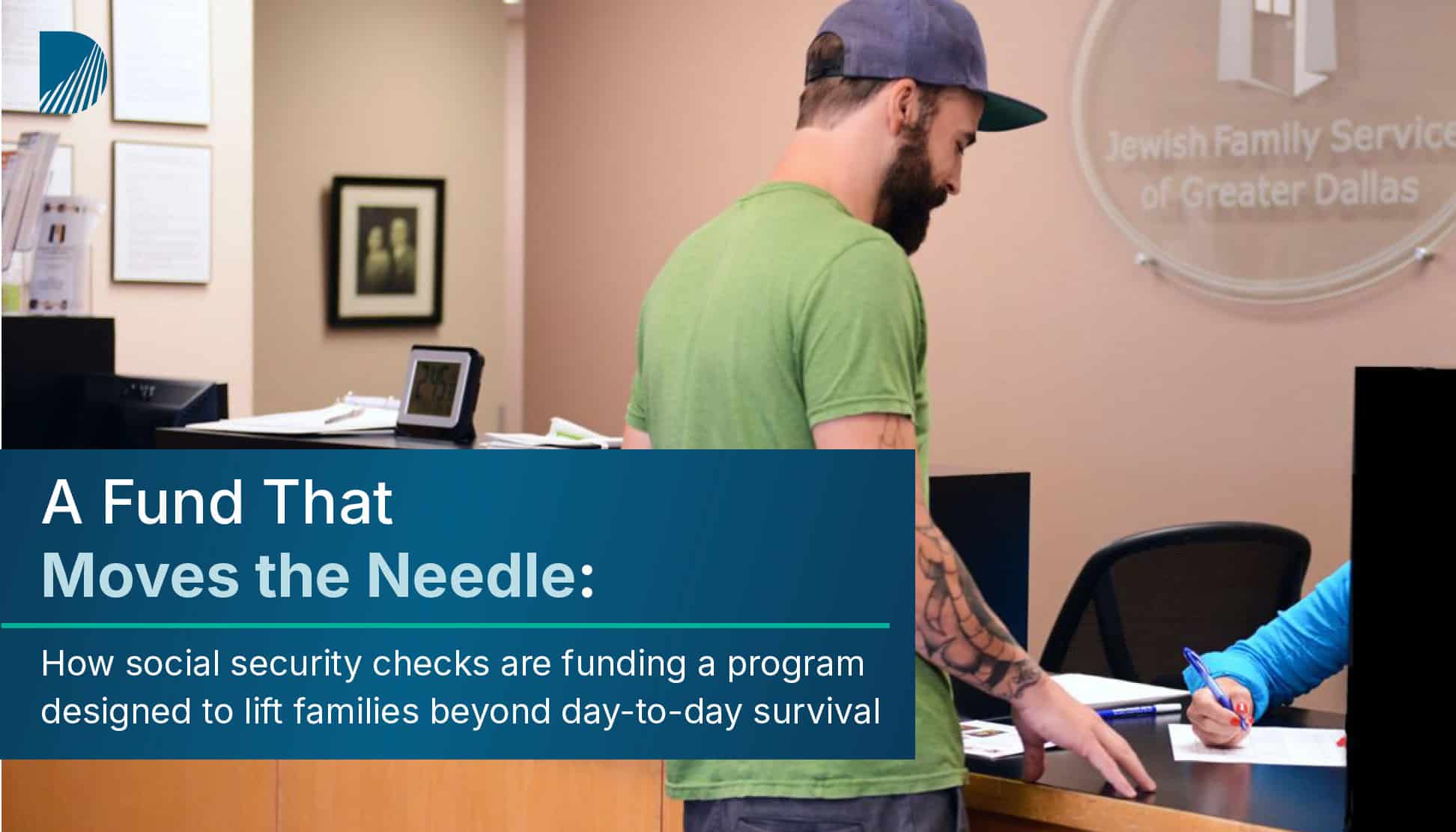
Her story is one of determination and opportunity—of what’s possible when generosity meets guidance. Through the Move the Needle program, created by The Dallas Foundation fundholders Ike and Candy Brown in partnership with The Dallas Foundation and Jewish Family Service of Greater Dallas, families like hers are finding new paths toward financial stability and brighter futures.
More Than Writing a Check
Ike and Candy Brown have philanthropy in their DNA. Since moving to Dallas in 1980, they’ve contributed to organizations across the city, from the Dallas Holocaust and Human Rights Museum to an endowment for Social Venture Partners Dallas (SVP) created through The Dallas Foundation.
Their involvement with SVP showed them that empowering others to improve their lives and communities was a fulfilling way to give. And it sparked an idea that would eventually become the Move the Needle program.
“We thought, we write checks, but where is that money really going? Are we really making a difference?” said Ike. “We knew we couldn’t boil the ocean, but we wanted to do something that had a measurable impact.”
The Browns had monthly social security checks coming in and figured the combined total was enough to help give a family a boost to cover immediate financial pressures and begin moving ahead.
“That would give a family a breather so they can get some money in the bank and not have to live paycheck to paycheck,” Ike said. “The hope was it would give them a new start, a new perspective.”
They knew the change they wanted to make, but they needed a partner to help transform their idea into a sustainable, measurable program.
Building the Program
Ike and Candy had a powerful idea: to help a hardworking family break the cycle of financial instability by giving them the breathing room to build toward a stronger future.
But turning that vision into a sustainable, compliant, and measurable program required a partner who understood philanthropy at both the strategic and operational levels. Someone who could build the framework, identify the right nonprofit partner, and ensure accountability.
That’s when they turned to The Dallas Foundation. When the Browns shared their idea with the Foundation’s philanthropic experts, Julie Diaz, President & CEO, and Kim Montez, Senior Director of Gift Planning and Family Philanthropy, the team immediately saw the potential and knew how to make it work.
The Dallas Foundation helped the Browns design a giving model that would not only provide immediate relief but also promote long-term stability. This meant finding a partner agency with the expertise to offer case management, financial coaching, and emotional support. Drawing on its deep relationships and local knowledge, The Dallas Foundation led a competitive vetting process to identify the nonprofit partner best equipped to deliver measurable results.
After a thorough process, the Browns chose Jewish Family Service of Greater Dallas (JFS), a nonsectarian social service agency known for its holistic approach to financial empowerment, mental health, and family support.
Together, The Dallas Foundation, JFS, and the Browns built what would become the Move the Needle program: a one-year initiative offering monthly financial support to an eligible family and helping them establish a savings goal that wouldn’t have been possible otherwise. The family would have access to all of JFS’ services, including financial coaching and job training.
JFS would find families that met certain criteria, evaluate each candidate by overall need and likelihood of success, and share their anonymized recommendations with the Browns to make the final selection.
To chart the family’s progress and keep them accountable, JFS’ financial coaches would use worksheets and tracking documents. The organization would also submit regular reports to the Browns and The Dallas Foundation so they could see the difference they were making.
“The partnership with The Dallas Foundation gave our idea credibility and structure,” Ike said. “They brought the right people together and helped ensure that every detail was thought through.”
With the program outlined, Move the Needle was ready to welcome its first family.
The First Family: Lessons in Growth
“The first participant was a single mother with three kids. She had a new job in downtown Dallas that she loved, and she was on a path that would really change things for her family,” Ike said. “But she had some things holding her back financially, so we were happy to help lighten her load.”
Most critically, the mother needed to provide her employer with her college transcripts as a condition of her employment, but she had an outstanding balance, and the college wouldn’t release them. She also had a decade-old car with 165,000 miles on it, a son whose asthma medication wasn’t yet covered by Medicaid, and a daughter in need of costly formula. To pay for the medication and formula, she pawned her recently deceased grandmother’s jewelry.
“The mother needed about $20,000 to get her to sea level,” Ike said. “So, we paid it and she started the program.”
The results were immediate. Her transcripts were released, and she was able to keep her job and even got an unexpected raise. She bought a newer car, freeing her of constant worrying about a breakdown and costly maintenance. And she was able to buy back her grandmother’s jewelry.
With her basic needs taken care of, she was on a path to achieving her dream: moving to a home in a safer neighborhood where she could be near family, continuing her education, and spending more time with her children.
“She’d been living in survival mode without the luxury of being able to think about the future,” said Cathy Barker, President & Chief Executive Officer at JFS. “Move the Needle let her realize that a different future, a different life, could exist for her and her family.”
Yet, with new opportunities came unexpected challenges. A change in her income temporarily affected her eligibility for benefits, leading to confusion about her finances. Misunderstandings about her raise and access to new funds resulted in some missteps, including unplanned spending and short-term borrowing.
“The first year was rocky but there was still a lot of good that came from it. We helped the family as much as we could,” said Ike. “But we didn’t want to drop the program. Candy and I just considered it part of the learning process.”
The Browns, JFS, and The Dallas Foundation viewed these setbacks as valuable lessons. Together, they refined the program. JFS provided the Browns with a list of recommended changes.
Participants would sign an agreement that clearly outlined expectations, and JFS would personally verify bank statements, paystubs, and receipts. Participants would also have to use JFS’ wrap-around care services, including financial coaching and, most importantly, mental health counseling. The family would also be given discretionary funds to prevent them from spending their savings.
With the new guardrails in place and deeper collaboration between the Browns, The Dallas Foundation, and JFS, Move the Needle was ready to welcome its second participating family.
The Second Family: Stability Achieved
The refinements made after the first year quickly proved their value. The program’s next participant—another single mother—entered with a focused goal: save enough for a downpayment on a home for her and her children.
JFS and the Browns worked quickly, helping the mother open two savings accounts—one for the home downpayment and another for discretionary funds. The mother immediately paid off her credit card debt, multiple outstanding bills, and bought essentials for her children.
JFS also referred her to behavioral health services and made sure she was set up with appointments, so she had the emotional support needed to sustain her progress and confidence.
By July 2024, the mother had saved nearly $14,000 and was optimistic about her family’s future. She was able to leave her second job and still pay for her children’s extracurricular activities – a welcome change for her and her kids.
Yet, by the middle of the year, health complications and a setback with child-support payments caused the mother to dip into her savings account. At the same time, her Employee Assistance Program counseling sessions concluded, leaving her without the psychological support that had helped her navigate early challenges. The stress of it all, coupled with falling below her targeted savings goals, thrust her into a momentary panic. She wanted to quit the program.
JFS intervened immediately. Her counselor reminded her that the goal was progress, not perfection, and quickly reconnected her to therapy with the organization’s on-site clinical administrator. The counseling was critical and saw the mother through the remaining three months, putting her back on track to meet her savings goal.
“The mother was able to save over $20,000,” said Ike. “It really pulled her out of the cycle of living paycheck to paycheck and on the path to owning her own home.”
According to Cathy Barker, the counseling services made all the difference.
“Pairing financial coaching and counseling are critical to the program’s success,” Cathy said. “The mental toll of trying to get ahead for so long and the upheaval that comes with suddenly having more money require the support of a behavioral health professional.”
Turning Philanthropy into Partnership
Now in its third year, Move the Needle is supporting a young man who had a tough upbringing but is working hard to improve his life. The program is helping him pay off his debt, buy a reliable car, and attain his associate’s degree.
All things considered, Ike and Candy Brown have made good on their philanthropic goals. Even then, they know that the program has its limitations. And every year is another chance to refine it and get one step closer to giving families the tools they need for a lifetime of financial stability.
“The second year, we knew that cutting off all financial support from one month to another wouldn’t work. It’s like falling off a cliff,” said Ike. “So, we worked with JFS to gradually decrease contributions every month for the first quarter of the next year.”
In addition to tapering contributions, the program participants are also able to continue using JFS’ services.
“Over the program’s three cycles, we’ve all learned a lot about how to best support participants,” said Cathy Barker. “While every participant’s situation is different, things like counseling services and flexible funding options lets them save and enjoy life in a way they couldn’t before.”
That partners’ spirit of continuous improvement—grounded in data, trust, and compassion—continues to guide their shared approach to helping families build lasting stability.
For The Dallas Foundation, Move the Needle embodies what happens when thoughtful fundholders pair their passion with the right expertise and community partners. With its local insight, philanthropic experience, and strong network of nonprofit relationships, The Dallas Foundation helped ensure the Browns’ generosity would translate into lasting change for families in need.
“Through the program, we made one-on-one connections and changed people’s lives for the better. That’s a really gratifying thing to do,” said Candy. “But there’s so much more opportunity to do good, and our hope is that other people in our position would want to have that experience.”
Looking ahead, the program’s partners are focused on expansion. The Dallas Foundation, the Browns, and JFS are exploring ways to expand the Move the Needle model to help more families achieve long-term financial stability, while giving other donors the opportunity to engage in meaningful, hands-on philanthropy.
“Through thoughtful design and collaboration, we’ve built a program that works,” said Kim Montez. “Our hope is that by sharing the model and lessons learned, we can inspire others to take action and make a tangible difference in their communities.”
“We made it as simple as possible. It’s not a complicated philanthropic model,” said Ike. “We’d love for others to join in so we can help more than just one family a year. The first step is awareness. It’s our hope that philanthropy is contagious and our story inspires others to join in.”
Through Move the Needle, generosity, expertise, and partnership have come together to create meaningful change — helping families move from surviving to thriving, inspiring fundholders to take action, and strengthening the Dallas community.