
When a donor establishes a fund at a community foundation, they bring with them something more than assets. They bring a vision: a deeply personal sense of purpose for the causes they care about, the communities they want to strengthen, and the legacy they hope to leave behind. Honoring that vision is not simply a matter of good administration. It is a promise.
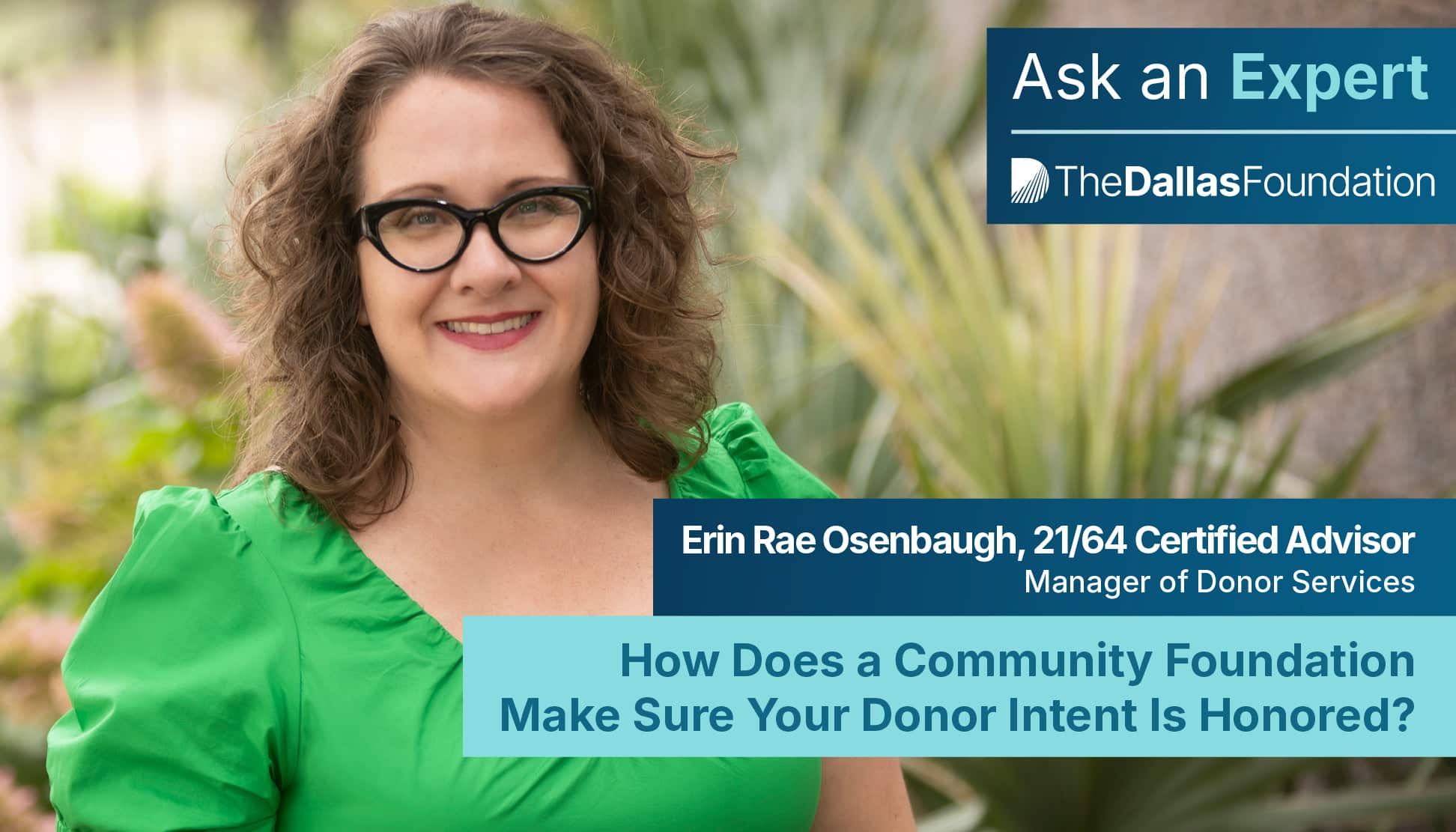
In this edition of Ask an Expert, Erin Rae Osenbaugh, Manager of Donor Services at The Dallas Foundation, explains how our team works with donors to capture, protect, and carry forward their philanthropic intent, not just at the moment a fund is created, but across the full arc of a giving relationship. From the first conversation to future generations, our philanthropic advisors are with you every step of the way.
What does “donor intent” actually mean, and why does it matter so much?
Donor intent is the “why” behind a fund. It encompasses a donor’s reasons for giving: the causes they care most deeply about, the organizations they trust, the communities they want to invest in, and the values they want their generosity to reflect. For some donors, intent is broad, a commitment to education or the arts or human services in Greater Dallas. For others, it is highly specific, focused on a particular neighborhood, a type of program, or even a single organization.
Why does it matter so much? Because a fund without a clearly honored intent is just a vehicle. The intent is what makes it meaningful. It is what connects a donor’s wealth to their values, and what ensures that their generosity, years or decades from now, still looks and feels like something they would recognize and be proud of.
At The Dallas Foundation, we treat donor intent as something close to sacred. Our founding commitment is to the donors, families, and communities we serve, and that means never treating a fund as a generic pool of assets. Every fund has a story, and we see our job as making sure that story continues to be told faithfully.
How do our philanthropic advisors help capture donor intent when a fund is created?
The process begins long before any paperwork is signed. Our philanthropic advisors sit down with donors, and often with their families or professional advisors, to have genuine, unhurried conversations about what they want their giving to accomplish. We ask questions that go beyond the mechanics of a fund. What drew you to this cause? What does success look like to you in five years? In twenty-five? Who in your family shares your passion for this work, and how do you want them involved?
This kind of careful, relationship-centered onboarding is part of what we mean by white-glove service. We do not hand donors a form and send them on their way. We invest the time to understand them, because that understanding is what allows us to serve them and their legacy well.
What happens when the landscape changes: an organization closes, a cause evolves, or a community’s needs shift?
This is one of the most important questions in philanthropy, and one that donors often do not think to ask when they are establishing a fund. The reality is that communities change. Organizations merge or close. A neighborhood that once had no youth programming may have it in abundance a decade later, while new needs emerge elsewhere. A fund that was perfectly calibrated to the moment it was created may need to adapt in order to remain effective and true to its purpose.
Our role is to be the thoughtful stewards who navigate those changes on a donor’s behalf. When a named grantee organization is no longer operating, when a field has shifted, or when new information suggests a different approach would better serve a donor’s intent, our team does not simply default to the path of least resistance. We go back to the donor’s original intent: the conversations we have had and the values they have articulated. Then we ask what would truly honor what this donor set out to accomplish.
In some cases, that means working with donors or their families to formally update a fund’s parameters. In others, it means exercising the kind of informed, values-driven discretion that comes from knowing a donor deeply. Either way, the answer is always grounded in intent, not convenience. This is what a community foundation can do that a simple charitable vehicle cannot: bring genuine expertise, community knowledge, and a long-term relationship to the stewardship of every fund.
Your Intent, Honored Today, Tomorrow, and Beyond
The Dallas Foundation has been connecting generosity to community need for more than a century, and the trust that donors place in us is something we take seriously in every fund, every grant, and every conversation. Honoring donor intent is not a policy. It is a practice, one that our team lives out through every relationship we build and every decision we make on a donor’s behalf.
If you are thinking about establishing a fund, reviewing an existing one, or simply curious about how your philanthropic goals can be better protected and advanced, our team is ready to talk. Our philanthropic advisors bring the expertise, the community knowledge, and the personal commitment to ensure that your giving continues to reflect who you are, no matter what the future holds.
We invite you to reach out to The Dallas Foundation to begin or continue that conversation. Your legacy deserves nothing less.