

Every philanthropic decision includes a question of timing. Should charitable resources be used more aggressively to address today’s needs, or should they be invested to provide support for generations to come?
The choice between spending down charitable capital and creating an endowment is not simply a financial decision. It reflects how individuals and families think about impact, legacy, and the role they want their philanthropy to play in a changing community.
Both approaches can create meaningful results. The right choice depends on what a fundholder hopes to accomplish, how quickly resources are needed, and whether the charitable purpose is tied to a particular moment or intended to endure.
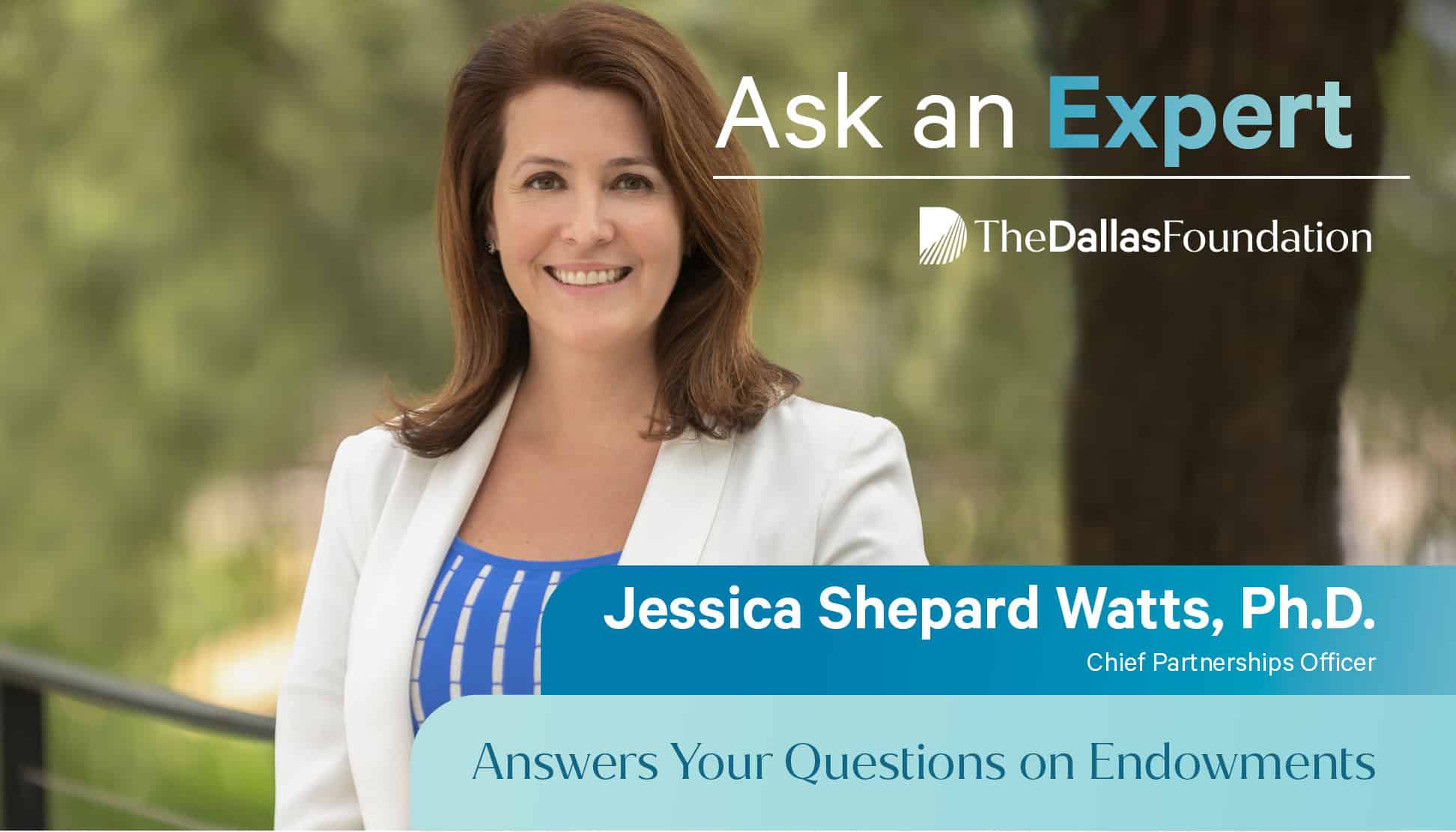
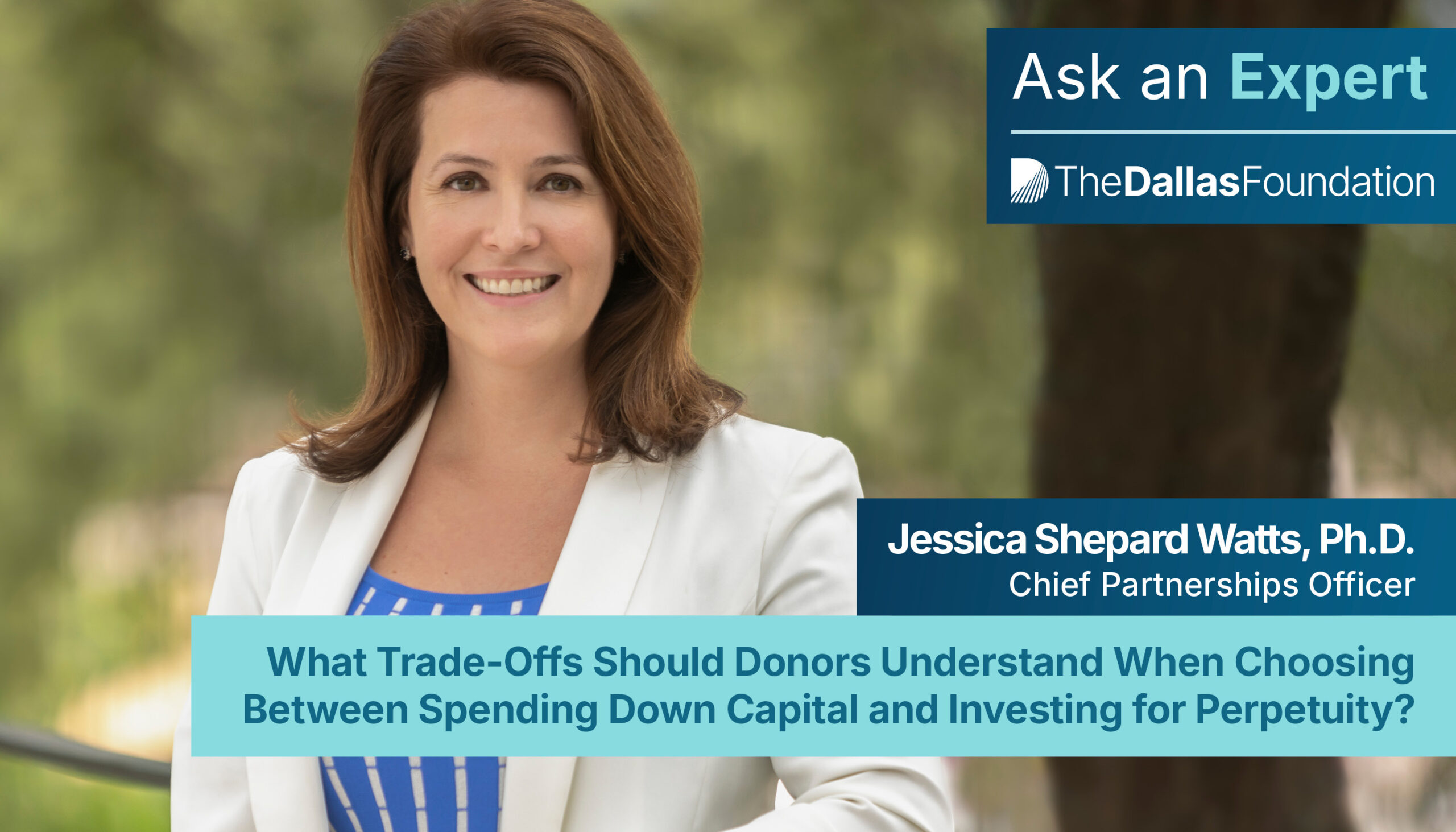
In this edition of Ask an Expert, Jessica Shepard Watts, Ph.D., Chief Partnerships Officer at The Dallas Foundation, explains the trade-offs between spending down capital and investing for perpetuity, addresses common concerns about endowment, and shares how fundholders can balance the needs of today with their hopes for the future.
What is the difference between spending down and investing for perpetuity?
A spend-down strategy intentionally uses both a fund’s investment returns and its original capital over a defined period. That period could be 10, 20, or 30 years, or it could extend through the fundholder’s lifetime. The goal is to deploy more resources within a particular window rather than maintain the fund indefinitely.
Investing for perpetuity creates an enduring source of charitable support. The assets remain invested, and a portion of the fund’s value is distributed for grantmaking each year. The investment and spending strategy seeks to support charitable work today while preserving the fund’s purchasing power for the future.
The difference is not whether the resources create impact. It is the timeframe over which that impact occurs.
Spending down concentrates resources within a particular period. An endowment extends a fundholder’s impact across generations.
If community needs are urgent, why not spend everything now?
This is one of the most understandable questions fundholders ask.
There are moments when significant, immediate investment is the right response. A humanitarian crisis, time-sensitive opportunity, or solvable problem may warrant deploying more capital now. Early intervention can also prevent challenges from becoming more costly or difficult to address later.
But urgency is not limited to the present.
Future generations will encounter challenges we cannot predict, alongside persistent needs that will require sustained attention. Investing every available dollar today may help address an immediate problem, but it also means those resources will not be available during the next economic downturn, public health crisis, or emerging community need.
An endowment is not capital sitting unused. It makes grants now while keeping resources invested to support the community in the future. This creates a renewable source of philanthropic capital rather than a one-time infusion of funding.
The question is not simply, “Where can these resources do the most good today?” It is also, “Will this need continue, and who will have the capacity to address it tomorrow?”
Does investing for perpetuity reduce the impact of a charitable gift?
An endowed fund will generally distribute less in its earliest years than a fund designed to spend down. That is an important trade-off to understand.
However, the comparison changes when impact is considered across decades rather than within a single year. An endowment supports charitable work through recurring distributions while the remaining assets continue to be invested. Over time, this can allow one gift to support multiple generations of organizations, leaders, and community members.
The Jean Baptiste “Tad” Adoue III Fund offers a powerful example.
Tad devoted much of his life to championing the arts. Through his will, he established an endowed fund at The Dallas Foundation with clear instructions to benefit the arts in Dallas County. That direction preserved his passion while giving The Dallas Foundation the flexibility to respond as the city’s cultural community evolved.
More than three decades after Tad’s passing, his fund generates more than $100,000 annually for theaters, museums, orchestras, performance groups, and other arts organizations. Over its first 33 years, it distributed more than $5.8 million in grants while growing to 165% of its original $3.5 million principal.
Those results challenge the idea that endowment postpones impact. Tad’s original gift has supported generations of artists and audiences while retaining the capacity to continue giving.
A spend-down strategy might have allowed the fund to make larger investments during its earliest years. By choosing perpetuity, Tad created something different: a permanent source of support capable of responding to organizations, ideas, and opportunities he could not have anticipated.
What if community needs or nonprofit organizations change?
Some fundholders worry that establishing an endowment will lock their philanthropy into a purpose that may no longer be relevant decades from now.
That concern reinforces the importance of thoughtful fund design.
A well-constructed fund agreement can clearly document a fundholder’s charitable intent while providing enough flexibility to respond as organizations, terminology, and community needs change. Instead of defining a purpose so narrowly that it may become outdated, fundholders can identify the underlying values, populations, issues, or outcomes they want the fund to advance.
For example, a fundholder may establish a designated endowment to support a particular nonprofit. The agreement can also address what should happen if the organization closes, changes its mission, or can no longer fulfill the original purpose.
A fundholder who cares about a broader issue, such as education, health, economic opportunity, or the arts, may choose a field of interest fund. This allows future grants to reflect the fundholder’s priorities while adapting to new organizations and approaches.
The Tad Adoue fund demonstrates this flexibility. His commitment to the arts remains clear, but the fund has supported different organizations and artistic opportunities as Dallas’ cultural landscape has evolved.
Perpetuity does not have to mean rigidity. With thoughtful planning and experienced stewardship, an endowment can preserve the spirit of a fundholder’s intent without assuming the future will look exactly like the present.
Does an endowment mean giving up family involvement?
For many families, an endowment creates more opportunities for engagement, not fewer.
A permanent fund gives multiple generations a shared philanthropic responsibility. Parents and grandparents can use it to pass along values, introduce younger family members to community needs, and create a structure for making decisions together.
Future generations may serve as advisors to the fund, participate in grantmaking, visit nonprofit organizations, and continue learning about the causes the family values. The fund becomes more than a financial asset. It becomes a way to preserve family stories and translate shared values into action.
Fundholders can determine how future generations will participate and what should happen if family members are no longer able or interested in advising the fund. The Dallas Foundation can then provide continuity, local knowledge, and stewardship as family circumstances change.
An endowment can preserve a family’s charitable identity while giving each generation a meaningful way to carry it forward.
When might spending down be the better approach?
Spending down can be appropriate when a fundholder has a clear, time-bound objective and believes concentrated funding could materially change an issue’s trajectory.
A fundholder may want to expand a proven program, help an organization complete a major initiative, respond to an emergency, or invest in a solution that requires significant upfront capital. Some fundholders also place a high value on participating personally in the work and seeing the results of their philanthropy during their lifetime.
The decision should still account for the capacity of the organizations receiving the funding. More funding does not automatically produce more impact. Nonprofits need the staff, infrastructure, leadership, and long-term plans required to use a substantial investment effectively.
Fundholders should also consider what will happen when the funding ends. If an organization expands a program or adds staff because of a large but temporary commitment, a responsible spend-down strategy should address how that work will be sustained, transitioned, or concluded.
Spending down works best when it is intentional, supported by clear goals, and paired with a thoughtful exit plan.
Do fundholders have to choose only one approach?
No. For many individuals and families, a blended strategy offers the most effective balance.
A fundholder might designate part of a fund for current grantmaking while investing the remainder as a permanent endowment. Another might make a significant, time-limited investment in an urgent issue while establishing an endowed fund to support the same cause over the long term.
A family could also spend down one fund under the current generation’s leadership while maintaining a separate endowment through which children and grandchildren can continue the family’s philanthropy.
This approach allows fundholders to respond to the needs they see today without giving up the opportunity to support the community tomorrow. The balance can also evolve as community conditions, family participation, and charitable priorities change.
How can The Dallas Foundation help fundholders make this decision?
Choosing between spending down and investing for perpetuity requires more than estimating investment returns or selecting a grantmaking rate. It requires a clear understanding of the fundholder’s goals, the community need, and the organizations positioned to address it.
The Dallas Foundation helps fundholders consider those factors together. Our team can facilitate conversations about values and legacy, provide insight into Greater Dallas’ nonprofit landscape, and help determine whether a goal calls for concentrated funding, permanent support, or a combination of both.
For fundholders considering a spend-down strategy, we can help identify organizations positioned to use larger investments effectively, structure multiyear commitments, and plan for the eventual conclusion of the funding.
For those considering endowment, we can help translate their vision into a fund structure that protects their charitable intent, supports meaningful grantmaking today, and remains flexible enough to serve the community in the future.
We also work alongside a fundholder’s financial, tax, and legal advisors so that the philanthropic strategy complements the family’s broader planning.
Our role is not to make the decision for the fundholder. It is to help them understand the implications of each path and build a strategy capable of delivering the impact they want to achieve.
Creating Impact That Endures
As The Dallas Foundation approaches its Centennial, endowed funds like Tad Adoue’s offer a tangible reminder that decisions made decades ago are still expanding what is possible in Dallas today.
Spending down can create powerful impact when a moment calls for concentrated action. But for fundholders who want their values to endure, an endowment offers something distinct: the opportunity to address today’s needs while preserving the capacity to meet tomorrow’s.
At The Dallas Foundation, we help fundholders find the right balance between those priorities. By pairing a clear charitable purpose with thoughtful planning, local knowledge, and long-term stewardship, an endowed fund can become more than a reflection of what mattered to one person or family.
It can become a permanent investment in the future of the community they call home.